Thursday, June 18, 2009


New Book!
One of the long-time Hastings' researchers, Professor Jerry Powell just saw a book he wrote with Paul Opler published. Reflecting over 100 years of research on the moths of western North America, it includes color photos of 2,350 species. We may not ever see the likes of Jerry and Paul again as it took them 50 years each to understand the moths of western North America. Our universities are no longer likely to provide the kind of long-term support to let experts do the field work and museum work to compile the knowledge of such groups. Modern research is focused on single animals and single biochemical or genetic phenomena, and the lack of understanding the biodiversity around us is creeping around us like a fog. There may be 8,000 species of moths in the West. Maybe 3,000 of them have no name and have never been studied. The authors present technical descriptions, along with drawings and photographs that will allow future students to get started. Certainly, it requires some demanding reading and some background in biology, but they include a treasure trove of natural history- what the larvae need, associated plant species and habitats where the moths thrive. If you just want to dazzle your friends with a stunning show of biodiversity, this book is great. If you or some 10-year-old you know want to learn more about moths, those silvery ghosts of the night lights, this is a start. Powell, Jerry A. and Paul A. Opler 2009. Moths of Western North America. University of California Press, Berkeley. 369 pp.

Tuesday, June 16, 2009


2009 Butterfly Count
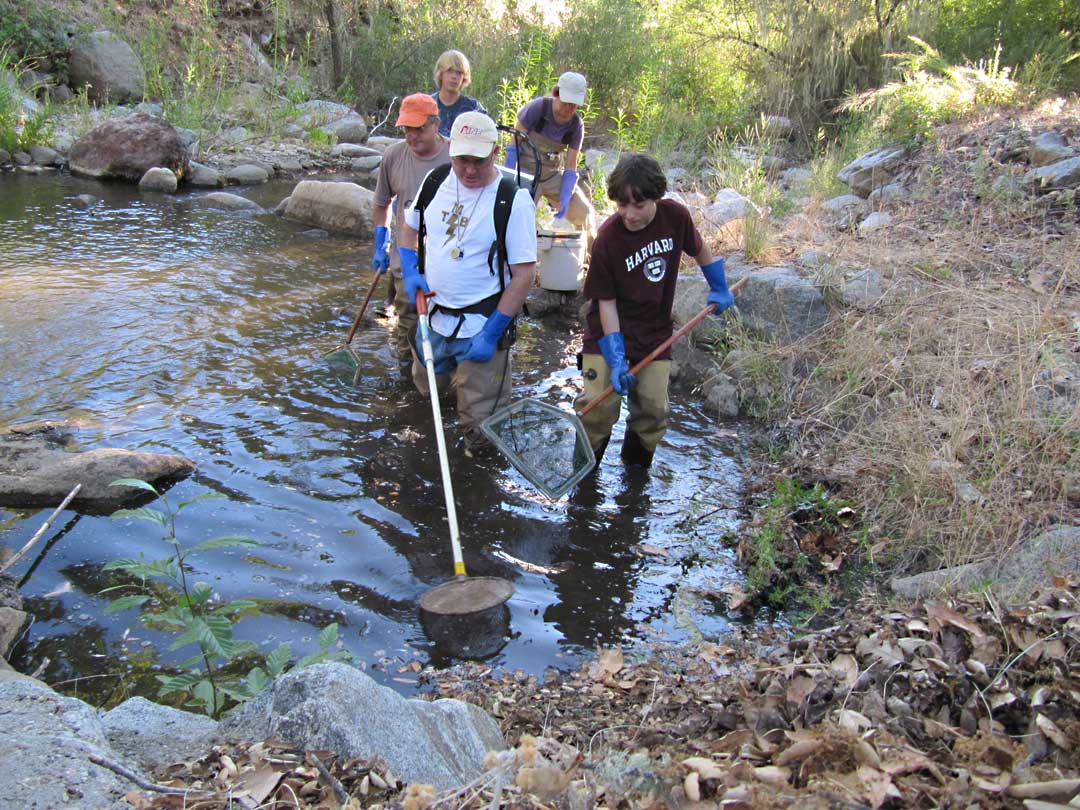
Today, Professor Jerry Powell and a crew : Liam O'Brien, Chris Tenny, Paul Johnson, Aurora Mahassine and Norma Davis, headed out to check the butterflies in a circle on the map centered on Hastings. Jerry, Norma and Aurora walked down the Arnold Road. Liam took the drive to Arroyo Seco and Paul and associates headed up to Chew's Ridge. Jerry reports that, as one would suspect during a dry year, the butterfly numbers are low again. About like last year. Check back in a few days and we should have the final tally.


Dr. Jerry Powell, Norma Davis and Aurora at the Arnold Cabin.

Sunday, May 10, 2009


Time to Add up Winter Rain Again...

Well, how did the upper Carmel River watershed do this rain year (July-May)? We are relatively dry this year, and had it not been for February rains, it would have been a exceptionally dry year. Finch Creek is flowing but under 2 cfs, and will be dry in a few weeks. Here are two graphics showing our winter and the rainfall record since 1929 at Hastings. You can click on either for a closer view of the data. Eighty years now for Hastings!

Friday, April 17, 2009


Hunt for Winddecker Cabin of 1870s.
In Linsdale's history of Hastings, he mentions that "IIn Reservation records the largest hill within the boundaries is designated Poison Oak Hill. For a time it was known as Winddecker Hill because a man by that name lived there from about 1872 to 1878." We actually never knew where Winddecker's cabin was located. Yesterday I was scanning some old maps drawn by Dr. Keith White who studied the vegetation, particularly the blue oaks here on Hastings. One of his oak study sites was on Poison Oak Hill and the map indicated the "ruins of Winddecker cabin", the associated nearby spring, and the "Old Red Tank". The spring was evidently developed by Winddecker so he could live there. Later this spring and Cement Spring were developed and used to keep stock tanks filled for cattle or sheep grazing Poison Oak/Winddecker Hill. All three of these features were on a map made in 1962. I called Keith today and he recalls that Jimmy Bell told him about the old ruin back in the 1960s and that is how it came to be on the map of oak study sites. Walt and I hiked up there today, and using Keith's map, we found all three. Click here for a slide show of what we found. Not much is left of the cabin- just one post, with a very thin plank nailed to it, and one hand-hewn floor joist. Poison oak is thick around the site, and indeed the hill is well-named.